
What Guilford Resident Records Cover
A useful name search is a set of narrow checks, not one master roll. Guilford keeps land and local vital records through the Town Clerk, assessment data through the Assessor, and map context through MapXpress. State offices handle voter status, licenses, and statewide vital routes. The Judicial Branch separates civil and criminal searches, while probate has its own Madison-Guilford district. Each row below answers a different question and carries its own access boundary.
| Record | What It Confirms | Where to Search | Access and Limits |
|---|---|---|---|
| Assessor property card | Owner of record, physical situs, mailing location, MBL, use, and assessment | Guilford Property Record Cards | Current portal; 2017 and 2013 cards can be requested, with older gaps. Assessment data is not a title opinion or occupancy proof. |
| GIS parcel record | Parcel shape, adjacent lots, layers, owner link, and MBL path | MapXpress and its parcel viewer | Maps updated July 2026 and property data nightly; about 10,979 parcels, but no full household list. |
| Recorded land index | Party names, transfers, document type, dates, legal description, and prior owners | Guilford RecordHub | Index and images run from 04/01/1972 through 08/19/2026; maps and surveys reach back to 10/30/1858. |
| Voter status | Current registration status and related town or district confirmation when returned | Connecticut Secretary of the State lookup | Live form fields were not verified. A $300 full-file route exists, while ballot choices and protected fields are not public. |
| Civil and criminal court index | Party or defendant role, docket, court, category, dates, status, and disposition when shown | Connecticut Judicial Branch | Coverage is not uniform by case type. Sealed, juvenile, protected, family, and medical categories have access limits. |
| Vital record or index | Birth, death, marriage, parent, spouse, and relationship clues | DPH Vital Records or Guilford Town Clerk | State records begin 07/01/1897. Local custody, eligibility rules, birth confidentiality, and Social Security number limits apply. |
| Probate file | Decedent, fiduciary, heirs, attorney, estate dates, addresses, and distributions when public | PD-34 Madison-Guilford Probate District | Online, public-computer, or paper routes may apply. Sealed material needs court authority and is not a current resident roll. |
| Business or license filing | Entity, principal, agent, credential holder, status, scope, and filing address | SOTS business search and DCP license verification | Useful for a public affiliation. A filing or mailing address does not prove personal residence. |
| Tax bill | Account, property, bill, payment, delinquency, or DBA route | Guilford MyTaxBill | Current municipal bill search with no ZIP filter; it is not a complete resident roll. |
| Library, newspaper, or yearbook | Historical address, household, relationship, obituary, school, or community clue | EBN Historical Room | Years, scans, indexes, and staff access vary. A request should name the address, date range, and record type. |
| Unclaimed property | Name or claimed-owner cross-check and possible historical clue | CTBigList | Treasury verifies a claim. A match is not proof that a person lives in Guilford. |
The best starting point depends on the question. A current-status question favors the state voter tool and a carefully matched property record. An ownership question favors the Assessor, GIS, and RecordHub. An older family question may need probate, an obituary, a yearbook, or an EBN staff request before any modern index becomes useful. No single result should stand in for the whole person.
Name Questions Before a Guilford Resident Lookup
Define the purpose before entering a surname. “Is this registration current?” is different from “Who owned this parcel?” A court question needs a docket or party role. A family question may need a parent, spouse, date, or town. A business question may call for an entity filing or credential record. A historical question may begin with an old address instead of a current name. The first answer determines which custodian can actually confirm it.
Use the narrowest lawful question that fits the source. For example, an Assessor result can support an owner-of-record statement, while a SOTS result can support a registration-status statement. Neither one supplies a complete household. Record the exact spelling, any known middle initial, the town, the date searched, and the reason the match appears relevant. That small log keeps a later court, vital, or archive result from being joined to the wrong person.
A same-name problem is especially easy to create when a surname appears in shore communities, rural corridors, or regional directories. Keep separate notes until at least two of name, date, place, relationship, and address align. If the question is about an older address, preserve the old street wording and parcel clues instead of forcing it into a modern number.
Confirming Guilford Names Across Records
Cross-checking works best when each source adds a new kind of evidence. Start with the name and town, then connect it to a parcel, a court role, a vital relationship, or a dated historical item. A deed party may be a seller or buyer. A voter match may be current registration status. A newspaper may identify a family link but omit a complete address. Treat those roles as clues with limits, not as interchangeable proof.
- Normalize the question and the name. Try documented surname variants, initials, a prior surname where legitimately known, and an approximate year without merging results.
- Use the Assessor owner or location search when the question is tied to a parcel. Copy the MBL, situs, mailing location, owner name, and the date of the result.
- Use MapXpress to reject a similar name attached to a different parcel. The map can connect a location to a legal description and adjacent-lot context.
- Check the Secretary of the State voter lookup for a current-status question. A non-match may reflect timing, a name variation, inactive or cancelled status, protection, or a portal limit.
- Search RecordHub as grantor and grantee, then compare the legal description and parcel. A recorded party proves a transaction, not present residence.
- Search civil and criminal court routes separately. Capture the docket, location, category, date, status, and any restriction before treating a result as relevant.
- Use the correct Town Clerk or DPH eligibility route for birth, death, or marriage facts, then cross-check with an obituary, directory, yearbook, newspaper, cemetery, or probate item.
- Docket
- A court case number and its index record. It identifies a case and its events, but it is not automatically the full paper file.
- Index versus image
- An index is the searchable description of a record. An image is the scanned instrument or page, and it may have separate access or printing limits.
- Certified copy
- A copy issued by the record custodian with a certification that it is an official copy. A web result or plain scan is not the same thing.
When a match is wrong, go back to the custodian that created the record. The Assessor handles parcel-card questions, the Registrar handles voter-status questions, the Town Clerk handles local recording or vital routes, DPH handles its vital correction process, and the court clerk handles docket or copy questions. Tie a correction request to the record date, number, or parcel rather than to a broad claim about a person.
Guilford Voter Lookup and Public Fields
Guilford's Registrar of Voters directs people to the statewide Secretary of the State status tool. That lookup is designed to answer whether a registration is current, not to publish a household file. Same-day registration is available on Election Day under the state information route, but a search result still reflects a status record at a point in time. The live form was blocked during research, so the exact fields a requester must enter are not stated here.
The centralized voter-file description identifies public fields that can include a registered name, residence or mailing address, party status where applicable, active, inactive, or cancelled status, district or precinct, polling assignment, participation history, year-only birth information, and confidential or protected flags. Participation history indicates that a person took part in an election. It does not show ballot choices. Social Security numbers, driver's-license numbers, full birth dates, and protected addresses are not ordinary public lookup output.
For a broader file request, the Secretary of the State lists LEAD at P.O. Box 150470, Hartford, Connecticut 06115, with LEAD@ct.gov and 860-509-6100. The listed fee is $300, with payment required before release. The current request-form link and exact file format were not exposed during capture, so no unverified column list or delivery promise belongs in a resident search result.
Note: The live voter form was blocked during capture, so no unverified search-field list appears here.
New Haven Court Searches for Guilford Residents
Guilford is served by the New Haven Judicial District. Part A at 235 Church Street handles serious felony matters. Part B and GA23 at 121 Elm Street handle C, D, and E felonies, misdemeanors, infractions, and motor-vehicle matters. The Judicial Branch case hub leads to separate civil and criminal paths, and probate is not the same as a trial-court docket. Federal matters use the District of Connecticut and PACER.
The Connecticut pending defendant search shows the name, year, court, and category route used for pending criminal and motor-vehicle questions. It is useful interface evidence, but it does not establish a complete historical archive.
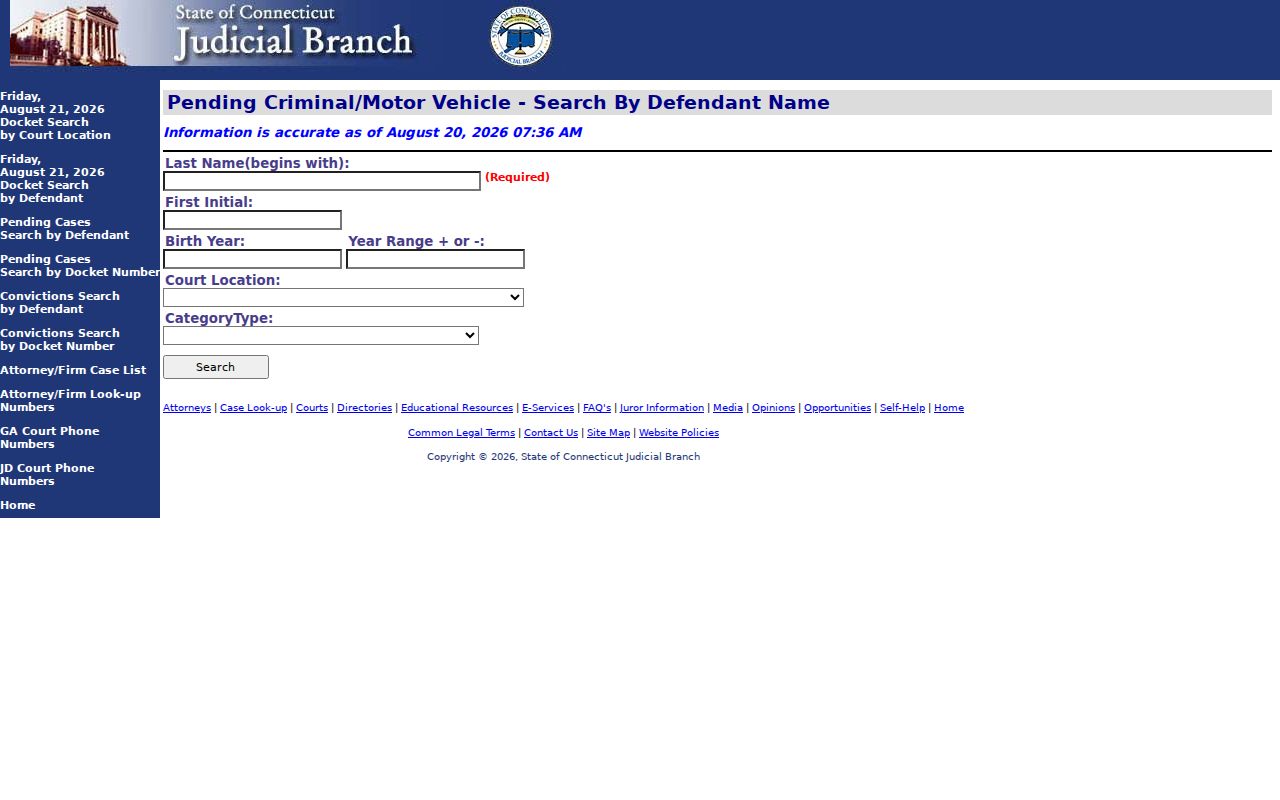
The pending-search screen is a route for a current docket question. A result still needs the court location, case category, dates, and status checked against the Judicial Branch record.
The daily defendant search is a separate, date-dependent route. A daily page can be useful for a current check, but a missed date is not proof that no older case exists.
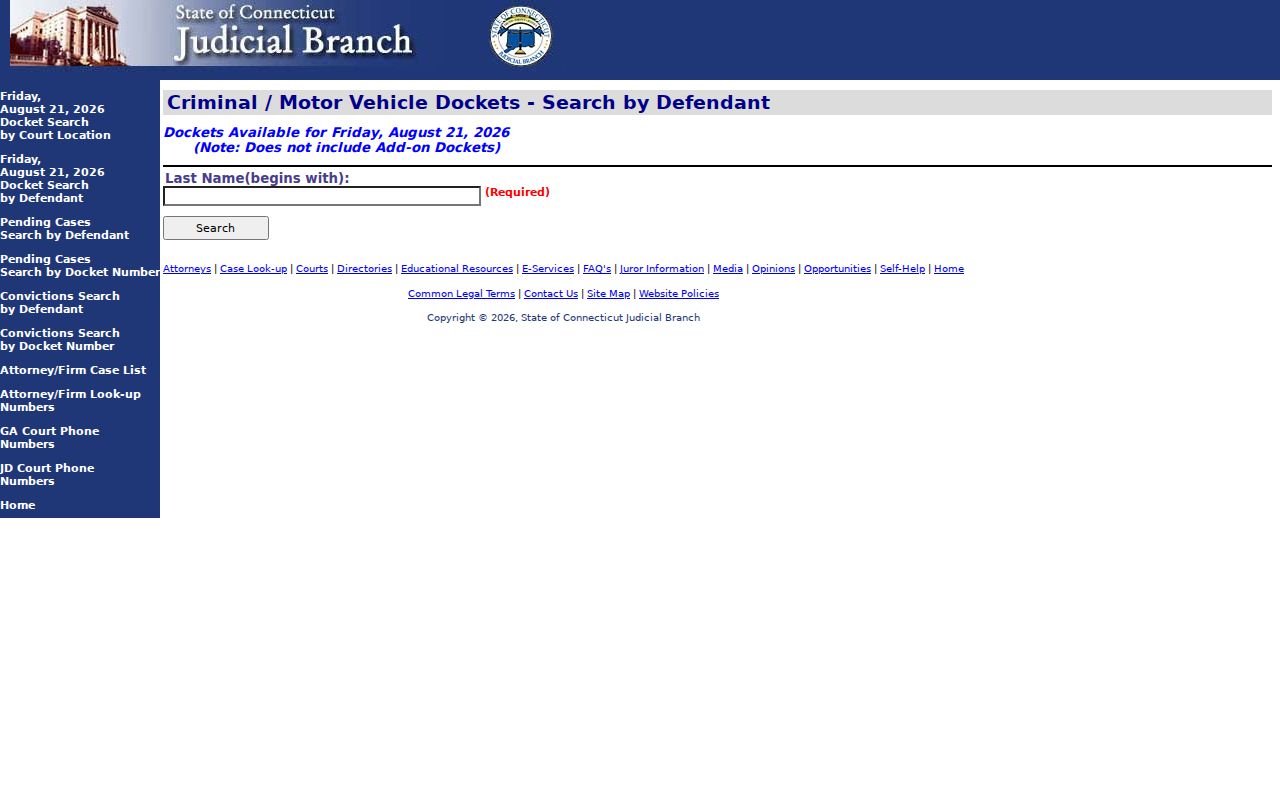
This daily search view should be read as a dated interface example. No live Guilford test name or personal docket result was captured, so the record inventory below stays generic.
| Search mode | Field | Required | What the field does |
|---|---|---|---|
| Civil | Party Name | No | Searches a party name; surname variants and initials need care. |
| Civil | Docket Number | No | Uses an exact docket-number route when the number is known. |
| Civil | Attorney or Firm Juris | No | Searches by attorney or firm jurisdiction. |
| Civil | Property Address | No | Limited to certain property-related civil routes, not a universal parcel search. |
| Civil | Court Location | No | Narrows the search to a courthouse or location. |
| Criminal pending | Last Name | Yes | Begins-with search for the defendant surname. |
| Criminal pending | First Initial | No | Optional first-letter filter. |
| Criminal pending | Birth Year | No | Year filter, not a full public birth date. |
| Criminal pending | Year Range | No | Sets a range around a selected year. |
| Criminal pending | Court Location | No | Uses the dynamic court-location list. |
| Criminal pending | Category Type | No | Uses the dynamic case-category list. |
A careful sample-result inventory records these fields when they are shown:
- Indexed party name and role, such as plaintiff, defendant, or another party role;
- Docket or case number, judicial district, and court location;
- Case category, status, file or return date, and hearing or event dates;
- Charges, issues, civil case type, disposition, judgment, sentence, or closing date when displayed;
- Related parties, counsel, attorney or firm information, and linked documents;
- Notice that paper, clerk, or courthouse access is needed for material not shown online;
- Sealed, juvenile, protected, redacted, or other restricted status.
Court lookup is not a complete identity or history report. A courthouse terminal can expose more for some case types than the web, while criminal documents are generally handled through the clerk or public-access route. The research captured no live Guilford party result and no single Guilford-specific copy-fee chart.
Vital Records in a Guilford Resident Lookup
Vital records answer relationship and life-event questions, not broad current-location questions. Guilford's Town Clerk is the local registrar. Connecticut DPH holds the statewide system from 07/01/1897 forward. A requester should choose the town route for a local event when speed matters, or the state route when a statewide copy is appropriate. Eligibility and the record's age control access.
| Record | Custody and coverage | Public boundary | Fee and timing notes |
|---|---|---|---|
| Birth | Guilford Town Clerk for local copies; DPH statewide from 07/01/1897 | Births under 100 years are confidential except eligible applicants under C.G.S. §7-51. At 100 years, the birth record becomes public. | Town form displays $20 full-size and $15 wallet, while the DPH summary says town birth copies are $20. State birth copy is $30. Verify before payment. |
| Death | Town of the local event or DPH statewide route | Certified copies are generally available to people age 18 or older. Social Security numbers on later deaths have restricted access. | Generally $20 per copy. A qualifying veteran spouse, child, or parent may receive one free copy with required proof. Town is generally quicker. |
| Marriage | Town of event or residence at the time of marriage, or DPH | People age 18 or older may generally request a certified copy without Social Security numbers. Parties or authorized people receive the restricted portion. | Generally $20. Form and payment instructions vary by route, and events under four months should be checked with the relevant town. |
| Divorce and older events | Judicial Branch file for the case; local registers, churches, library, or archives for pre-statewide material | A divorce certificate is not the full court file. Older events do not carry a statewide modern-copy assumption. | No Guilford-specific divorce form and fee were isolated. Verify with DPH or the New Haven clerk. |
Town and state requests can be made by mail or in person, and DPH identifies VitalChek as the approved online or phone vendor. Forms ask for record details, requester identity, relationship, signature, ID, copies, and payment. State processing can take up to 12 weeks, while the town is generally quicker. Do not treat an index clue as permission to order a restricted certificate or to reproduce a Social Security number.
Note: The town birth form and DPH summary show different wallet-copy amounts, so confirm the current Guilford fee before sending payment.
Guilford Resident Lookup Tip: Situs and Mailing
The Assessor separates the physical situs from the owner's tax-mailing location. Situs means the Guilford parcel and street number used for the map, permits, zoning, and legal description. Mailing means where tax correspondence is sent. It may be outside the parcel, outside Guilford, or a P.O. Box. The Assessor address-change page explains that a tax bill may be generated after six-month postal forwarding and that the Tax Collector sends to the last known address.
That distinction is a practical safeguard. A mailing location can help connect an owner to a record, but it is not proof of occupancy. The property card also carries MBL, use, acreage, zone, and building fields, while the map supplies the parcel shape and neighboring context. Keep “owner of record,” “mailing location,” and “physical situs” as three separate labels in any resident lookup notes.
MapXpress property information is updated nightly and parcel maps were reported as updated in July 2026. Its approximately 10,979 parcels are a parcel count, not a count of residents or households. Use the MBL and legal description to reject a similar name attached to a different Guilford parcel.
A Guilford Resident Lookup Myth: One Hit
An owner record, voter-status match, or deed party is not a complete person record. The owner may live elsewhere, a voter may be protected or inactive, and a deed party may be a seller, trustee, estate, or other role. A tax bill confirms an account or property route. It does not turn a parcel into a list of everyone connected to it.
The same rule applies to a court index, a professional license, a business filing, and an unclaimed-property match. Each record has a defined purpose. A court result can identify a docket and dates without proving a current address. A DCP result can show credential status and scope without proving a Guilford home. CTBigList can start a Treasury claim process without proving residence. The reliable answer comes from matching record roles and dates, then stopping where the public evidence ends.
Note: A current owner, deed party, or voter match supports one record claim, not a conclusion about a full household or present occupancy.
Probate, School, and Archive Clues
Some person questions are better answered by a local collection than by a current portal. PD-34 Madison-Guilford Probate can expose a decedent, fiduciary, heir, attorney, or estate address when the file is public. The Probate case-document route supports online features, a public computer, or paper access for qualifying records, while sealed documents need a court order. Probate is an older-address and family trail, not a current-person locator.
EBN Historical Room holdings add directories, census microfilm from 1800 to 1930, early tax lists, newspapers, maps, photographs, and yearbooks. Its research-question form can support an address-based request for a scan or staff search. The Guilford city directory collections are especially useful when a name needs a year, street, school, or household anchor.
Choose the companion source that fits the question:
- An heir question can pair probate with an obituary, deed transfer, or cemetery clue.
- A former classmate question can pair an EBN yearbook with a dated school or newspaper item.
- A family connection can begin with eligible DPH records and authorized adoption or court routes.
- A public affiliation can pair SOTS entity results, Guilford trade names, and DCP credential details.
- An old address can pair a deed chain with directories, newspapers, the historic survey, or later probate.
The archive gap matters. Indexing may omit a year, scan, household member, or street variant. Ask for a date and address, preserve the repository's wording, and accept a no-result when the collection does not support a stronger conclusion.
The probate access screen is available through the Connecticut Probate Court document route.
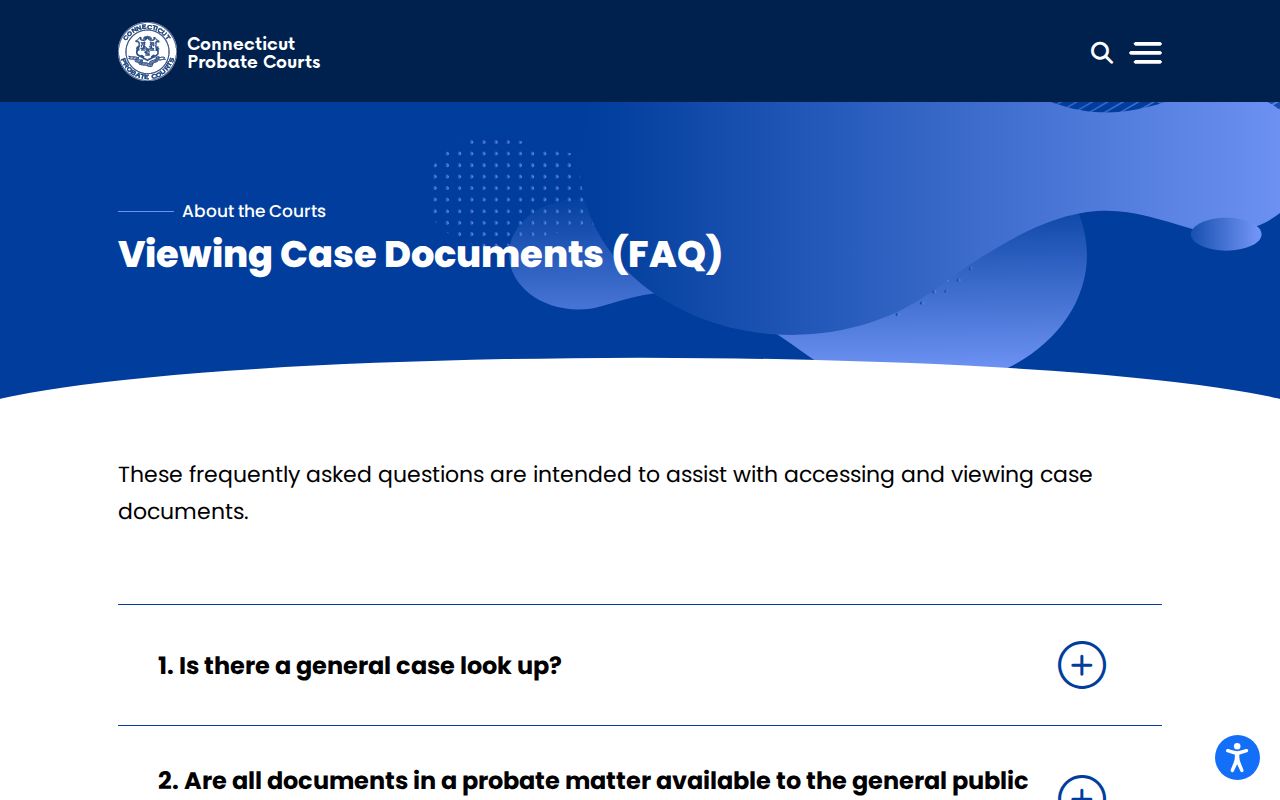
This image points to the public document-access route. It does not represent a live Guilford person, open sealed file, or complete result set.
Privacy Boundaries for a Guilford Resident Lookup
Connecticut's Address Confidentiality Program, known as Safe at Home, gives qualifying participants a substitute address and mail-forwarding service. The actual residence can be withheld from ordinary release. SOTS voter privacy can suppress a name and address when disclosure would endanger a person or family. C.G.S. §1-217 also permits residential-address nondisclosure for certain protected officials and public-safety roles. A protected result should not be rebuilt by joining nearby parcels, old directories, or association pages.
DMV personal information is closed under C.G.S. §14-10 and the federal Driver's Privacy Protection Act. Utilities and delivery records are not a public block or household source. Court, vital, probate, adoption, and recorded-document restrictions still apply even when another database contains a related name. If a source is wrong, correct the source with the custodian. Do not copy Social Security numbers, financial account numbers, or protected addresses from an older image.
Lawful use. A Guilford resident lookup is for personal, lawful research such as family history, reconnecting, civic questions, or safety awareness. Using records to stalk, harass, intimidate, or harm anyone can violate Connecticut law.