
Guilford City Directory Coverage
There is no single continuous Guilford city directory run in a public catalog. The strongest documented series is the Connecticut River Valley (South of Middletown) Directory by C. DeWitt White Co. of Providence. The Gale guide identifies a 1913/14 to 1928 regional reel, but several years are missing. A separate 1913 Guilford town directory is documented through the library's History Hunt material. Those two leads form the sound starting point, while state and national collections help test later or missing years.
| Collection | Years | Where Held | Access and use |
|---|---|---|---|
| Connecticut River Valley Directory, C. DeWitt White Co. | 1913/14-1928 | Gale guide and institutional access | Regional names, addresses, trades, and street clues; local shelf not confirmed |
| 1913 Guilford town directory | 1913 | EBN History Hunt research path | Local address and business context; individual scan not publicly available |
| Connecticut State Library directories | Varied | Books, microfilm, and microfiche | Search by Guilford, regional title, and neighboring towns |
| LOC and later collection leads | Item-specific | Library of Congress and library databases | Useful supplements; later volume and scan details require verification |
The Gale-described run omits 1917, 1920 through 1923, and 1925 through 1927. No last printed year was verified. Leads for 1963 and 1982 entries, plus bound-directory leads for 1983 and 1985, should be treated as checks to make with a library account or special-collections desk, not as proof of a complete series. A useful catalog note says which title, publisher, town heading, and shelf or database was actually inspected.
The E. B. Newton Historical Room is the local starting point for the shelf, related tax lists, and the people who can route a question when an online scan stops short.
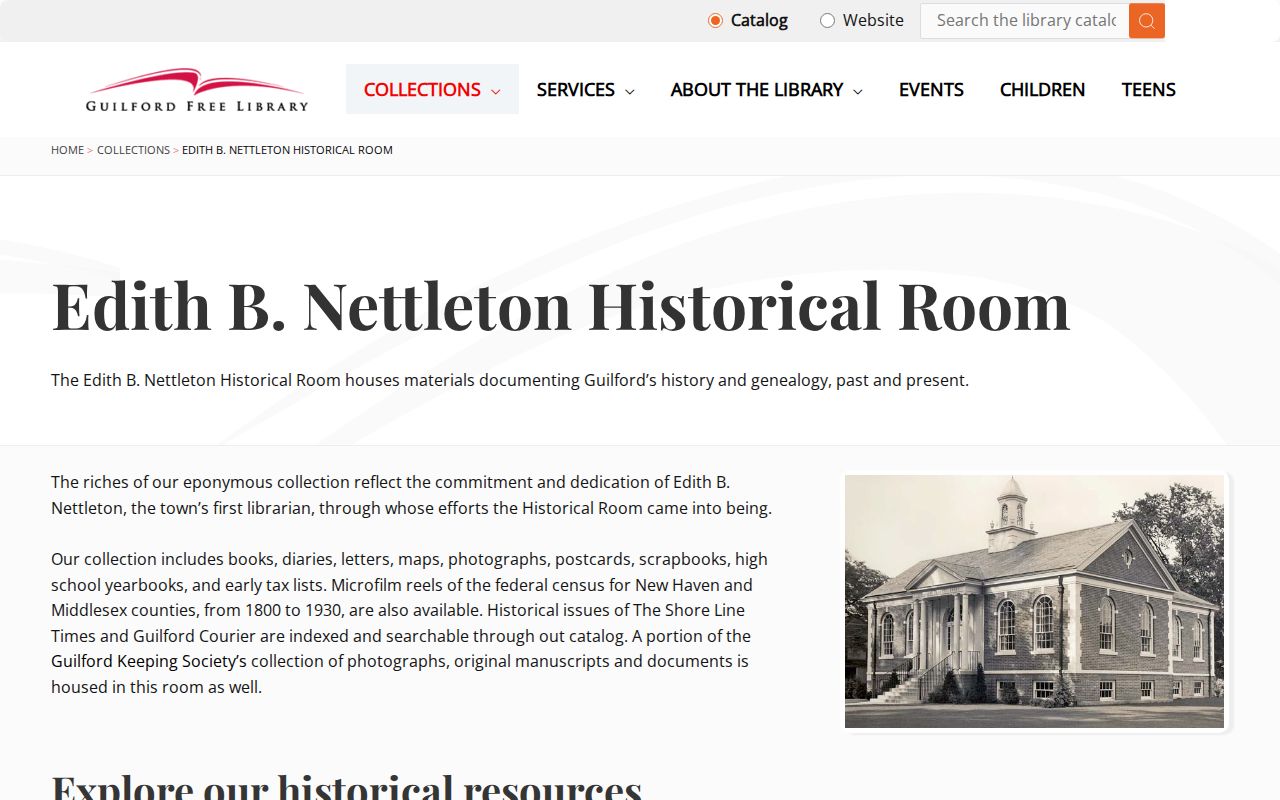
The room's local-history holdings add context to a thin directory entry, especially when a street, family name, or business needs a second source.
The 1913 Guilford City Directory Lead
The 1913 Guilford town directory is valuable because the research trail points to a real local exercise rather than a made-up sample person. The EBN History Hunt uses 7-11 Water Street and a movie-theater clue. That detail gives a researcher a fixed number, a street, and a business question. Start in the street or address part of the volume, then test the business against a newspaper, map, or later directory. The goal is to learn how the volume works while keeping the source boundary clear.
An individual 1913 scan was not publicly available in the research capture. Do not fill that gap with a guessed name, spouse, trade, or status mark. Use the Guilford History Hunt source guide and the Gale Connecticut River Valley directory guide to locate the correct research path. If a page becomes available through a library or institutional collection, transcribe only what the page shows and record the page or section heading.
Research habit. Treat 7-11 Water Street as a method clue. Find the printed address, identify the business reference, and then confirm the same place in an independent local source.
Where Guilford City Directories Live
The EBN room at Guilford Free Library, 67 Park Street, holds books, diaries, letters, manuscripts, maps, photographs, postcards, scrapbooks, high-school yearbooks, early tax lists, and more than 300 locally relevant books. It also has New Haven and Middlesex County federal census microfilm for 1800-1930, Shore Line Times and Guilford Courier indexes, Connecticut Shelf material, Guilford Keeping Society material, and a digital archive containing hundreds of photographs, documents, and works of art. These collections make the room more than a place to look for a single bound volume.
Displayed EBN Historical Room hours are Sunday closed, Monday 9-8, Tuesday and Wednesday 9-6, Thursday 9-8, Friday 9-5, and Saturday 9-1. The general library schedule can differ, so call 203-453-8282 before a special-collection visit. A staff-assisted request can be more useful than a broad catalog search when the question includes an old street number, a family spelling, or a business that appears only in an advertisement.
The research visit form asks for a name, email, research question, response preference by email or postal mail, mailing address, city, state, ZIP, and phone or contact details. Staff can gather relevant documents and scan, email, or mail them. No universal fee chart was found, so ask about reproduction or research charges before requesting a large packet.
The EBN digital history archive shows how local material is being made easier to inspect, although it is a work in progress rather than a complete city directory run.
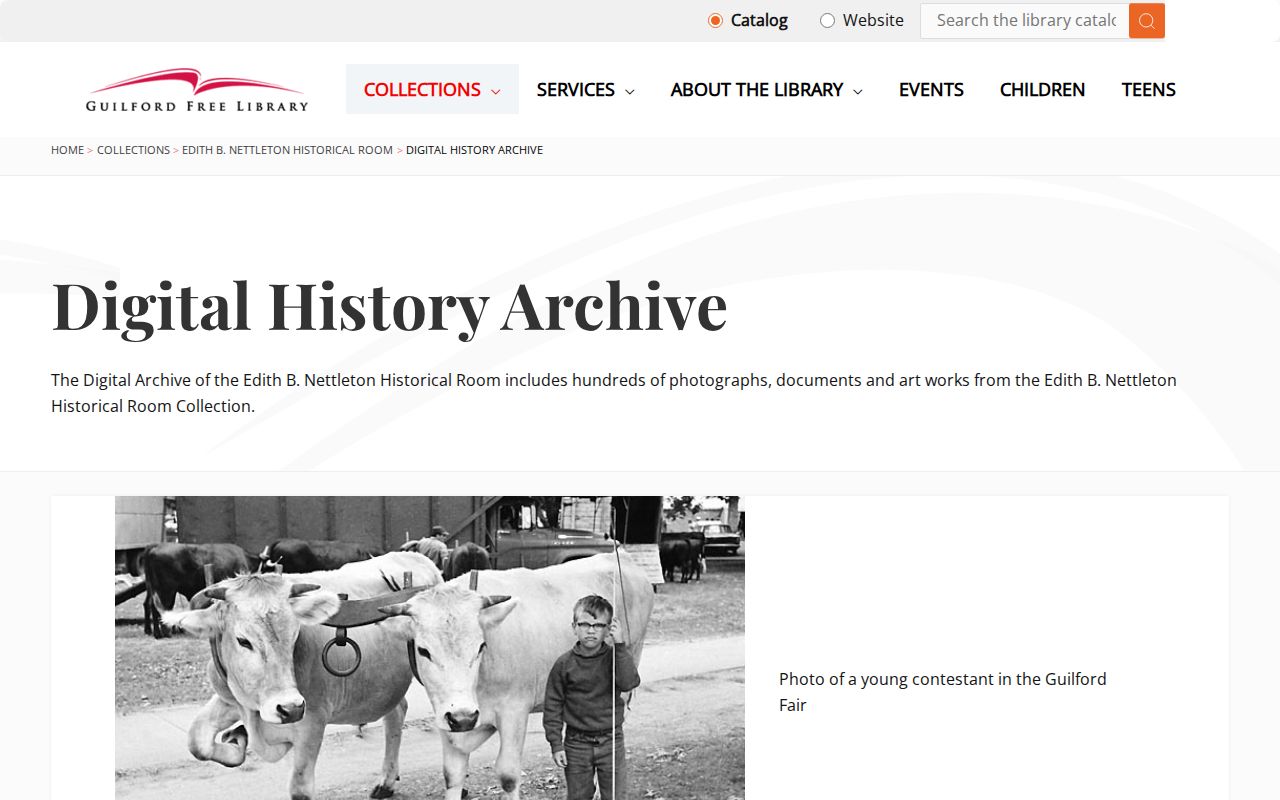
Use the archive for a dated image or document lead, then ask the library which physical collection holds the fuller context.
Guilford City Directory Name And Street Sections
A city directory often has two search paths that answer different questions. The alphabetical name section begins with a surname and given name or initial. It may point to a street number, town, business or trade, and a relationship or status note. The street or address section works in the other direction. It begins with a number and street, then may name a household or business found there. A name hit does not automatically prove a person lived at the address, and an address entry does not establish ownership.
For a Guilford search, write down the town heading and the exact street spelling before moving between sections. Shoreline names, island communities, initials, married names, and older place labels can change the order of a result. Leete and Leetes are a documented kind of spelling variation to test, not a reason to merge two people without a date or address check. The 1826 creation of Madison from Guilford also matters when a record sits near that historical boundary.
The street section is especially useful for the 1913 Water Street exercise and for a past-household question. If the volume has a criss-cross section, use it to move from the printed address to the named entry. If it lacks one, search the name section, then confirm the number in a map, newspaper, tax list, or later directory.
Reading A Guilford City Directory Entry
Directory entries are compact, and the abbreviation key can carry as much meaning as the line itself. A safe transcription records a visible field without expanding a mark into a fact. The 1913 research notes identify the fields below as a checklist for an actual scan. They do not supply a sample individual entry, so each item stays conditional until a page can be seen.
| Name | Surname and given name or initial, copied as printed |
|---|---|
| Relationship | Spouse or other relationship only when the volume prints it |
| Trade or business | Business or professional description as shown in the line |
| Address | Street, number, and town heading, including a visible unit or qualifier |
| Owner or status mark | Record an occupancy or widow/status abbreviation only when visible |
| Advertisement or section | Page, ad, street section, and heading that give the entry its setting |
Photograph or note the abbreviation key before reading a long run. A letter may identify a street section, a residence, a business, or a status convention that changes from one publisher to another. Do not assume that a blank field means no spouse, no trade, or no status mark. It may simply reflect the editor's format.
- Criss-cross directory
- A reverse directory arranged by street and number, useful for moving from an address to a named household or business.
- Householder index
- A name-led finding aid that points to the person or household line; it is not a complete list of everyone connected to a parcel.
- Abbreviation key
- The publisher's guide to short marks and symbols, usually worth locating before interpreting an entry.
Guilford's Local History Shelf
Directory work in Guilford benefits from the town's unusually connected history collections. The library tradition reaches back to a 1737 shared-library story serving Guilford, Saybrook, Killingworth, and Lyme. The modern EBN room carries that research role through local books, tax lists, newspapers, maps, photographs, and yearbooks. A thin directory line can therefore be paired with a dated image, a school page, a tax reference, or a newspaper notice without forcing every question through the same index.
The Guilford Keeping Society adds historic photographs, journals, daybooks, memorabilia, and archives. GKS began in 1947 as the Old House Group before taking its current name. Its archive is strong on historic buildings and associated families, but the Society does not publish a complete name index or member directory. Ask with a person, address, and date rather than assuming a public online roster exists.
The Society's public collection context is visible through its Guilford archive and historic-house resources.
That preservation layer can explain why an old address appears in a photograph or journal even when a directory year is missing.
Filling Guilford City Directory Gaps
A missing volume does not end a household trail. EBN newspaper resources point to Shore Line Times and Guilford Courier material, the transcribed Leete's Island Times from 1879-1882, the Guilford Echo from 1905, and later HeritageHub obituary coverage from about 2010 to the present with a library card. A newspaper can add a move, marriage, death, school connection, group role, or business name that a directory does not carry. Treat an obituary address as a dated historical clue, not as proof of a present address.
Use the EBN newspaper resources after noting the directory gap and the last known street number. Search the surname, spouse or child, business name, and street spelling. The result should be copied with its issue date and page or index description. If the newspaper names an organization or cemetery, follow that clue through EBN, the Guilford Keeping Society, or the repository that holds the record.
High-school yearbooks are another local companion for a school-era question. Record the year, class or club label, and page. Do not copy unrelated personal details. Cemeteries can close a family-history loop, but no official searchable Guilford interment database was located, so ask the library, cemetery custodian, or historical society for a burial reference.
Pairing Guilford City Directories And Census
EBN holds New Haven and Middlesex County federal census microfilm for 1800-1930. The federal 72-year rule means the 1950 census is the most recent released decennial census as of the research date, so a historical household trail uses 1940 and earlier when it needs a public census image. A census is a household snapshot. It does not replace a deed, prove a current address, or show every person who used a street number between enumerations.
Pair a directory year just before or after a census year. Compare the household names, ages, birthplaces, relationships, and street or locality fields. Then use a newspaper or obituary to explain a change. FamilySearch's Connecticut catalog can supplement this work with wills and deeds, births, deaths, marriages, and place-based leads, but account or contract limits may apply and the local book remains the better authority for a Guilford deed.
The most useful comparison is often simple: the directory supplies a year and address, the census supplies household context, and the newspaper supplies an event. When those pieces disagree, preserve the disagreement and check the street number, spelling, map reference, and record date before choosing a match.
Guilford Directory Research Timeline
Several local milestones explain why Guilford city directories now sit beside manuscripts, maps, and preservation files. They also show why a search should name its custodian and year rather than treat the town as one searchable database.
| Period | Research marker | Why it helps |
|---|---|---|
| 1639-1643 | Settlement began in 1639; Guilford was established and named in 1643 | Early records are distributed across town, church, colony, and later archive collections |
| 1737 | Shared-library tradition connected Guilford with neighboring communities | Provides context for the EBN research bridge |
| 1913-1928 | Local 1913 lead and regional C. DeWitt White run | Clearest documented printed-directory era, with explicit gaps |
| 1947 | Guilford Keeping Society began as the Old House Group | Explains the strength of house, photograph, and family-history material |
| 1981 | Preservation survey covered about 450 older buildings | The five-volume EBN set adds an address-based house-history lead |
Henry Whitfield State Museum is another historical route, not a current people directory. Its historic house is closed for rehabilitation from August 19 through December 31, 2026, while the visitor center remains open under the current notice. Arrange research-library access before travel and verify the notice again.
Using Guilford City Directories For Family History
A good family-history search keeps each directory year separate. Start with the clearest name, street, or business clue, then move through the next available volume without assuming that a missing year means the household disappeared. When the question is really about one address and its ownership trail, the Guilford previous residents page adds deeds, parcel identifiers, and the owner-versus-occupant distinction.
Use this order for a household trail:
- Find the first available Guilford year and copy the name, number, street, town heading, and any visible business or relationship note.
- Check the next available year alphabetically and by street, then test initials, spouse or child names, a business name, and a documented street spelling.
- Pair the address with the nearest EBN census microfilm year and note which household details agree or remain uncertain.
- Use a newspaper, obituary, yearbook, map, tax list, or preservation file to date a move or explain a gap.
- Close the trail with a later deed, probate or cemetery reference, while keeping a dated source note for every conclusion.
A name can disappear because a volume is missing, the person moved, the editor omitted the entry, or a family member was listed under a different form. Only a second record can separate those possibilities. The result is strongest when the search log preserves the exact printed form, the source custodian, and the point where evidence stops.