
Find Guilford Residents by Clue
A name and an address do not lead down the same path. Current ownership starts with Guilford's property card and parcel map, while registration questions go to the Connecticut Secretary of the State. An older household may need the E. B. Newton Historical Room, a newspaper index, or a street section from an old city directory. Court, vital, probate, business, and license records each sit with a different custodian and its own access rule.
Begin with the narrowest fact you hold. Then record the date, the source, and the role shown for the person. An owner is not always an occupant. A deed party is not always a resident today. A directory entry is only a dated clue, and holding these distinctions apart keeps a plausible name from hardening into a false household match.
- Fix the place. Search the Guilford Assessor or MapXpress by owner, location, street, MBL, unique identifier, or parcel ID.
- Check the right status. Use the statewide voter lookup only for a current registration question, not as a complete household list.
- Follow the recorded trail. Search Guilford RecordHub by grantor, grantee, document, date, or legal description.
- Test the historical clue. Compare directory years, census film, newspapers, yearbooks, probate, and cemetery leads at the library.
- Ask the custodian. Use the Town Clerk, Building and Engineering, court clerk, DPH, probate court, or Connecticut FOI route when an index ends.
Search order: name or address first, then parcel and role, then an independent date or place, then custodian confirmation. A match that fails this check stays a lead.
Offices Behind Guilford Resident Records
Guilford's records are spread across town, state, district, and library custodians. The Town Clerk at 31 Park Street is the hub. The office keeps land records, maps, surveys, trade names, local vital records, licenses, and voter routing. It also handles records requests. The Assessor supplies the property-card evidence. Statewide registration belongs to the Secretary of the State. Trial dockets sit with New Haven Judicial District. The Madison-Guilford Probate District PD-34 handles estates and related filings.
The Guilford Town Clerk page posts a counter schedule of 8:30 a.m. to 4:30 p.m. The schedule runs Monday through Friday. Recordings stop at 4:15 p.m. The office phone is 203-453-8001. The Clerk also offers a paper street map. It is a handy bridge when an older printed reference and a current parcel label use different wording.
Connecticut Elections
Statewide status lookup
Secretary of the State
860-509-6100 for LEAD
For older material, the EBN Historical Room is the practical offline bridge. It sits at 67 Park Street. Early tax lists, maps, photographs, yearbooks, newspapers, and census microfilm fill its shelves, and each office answers a different part of the Guilford residents directory question. The Guilford Town Clerk record page is the local starting point. It routes land, vital, voter, and records requests.
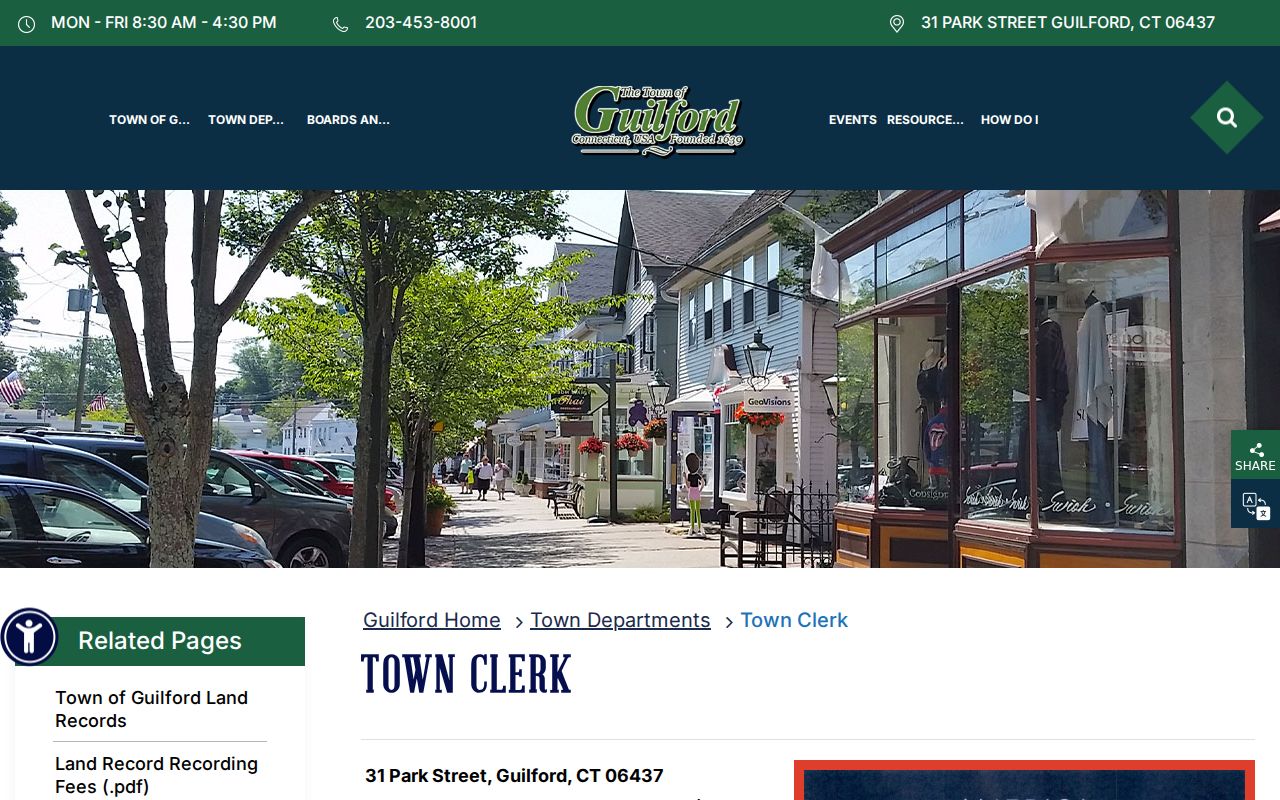
The page is an office doorway, not a household list. Guilford keeps no single public roster of residents, so take each record question to its named custodian.
New Haven County's Town-Level Record Path
Connecticut's county lines are geographic only. New Haven is the county seat. Yet no modern New Haven County recorder or county clerk holds Guilford's land records. The Connecticut State Library town and county guide explains the state structure, and the Guilford Town Clerk remains the recording authority for deeds, maps, surveys, trade names, and local vital records.
That local shortcut matters. Anyone hunting a county deed desk should use Guilford's RecordHub and Town Clerk route instead. Court questions move to New Haven Judicial District. Probate goes to PD-34 Madison-Guilford. Statewide vital, voter, license, business, and correctional records belong to their state agencies, and the county label describes coverage without pointing to any single county database.
Local routing tip: send a Guilford land-record question to the Town Clerk, not to a generic New Haven County office. Ask the Clerk which town, state, or district custodian holds a different record type.
Guilford's long record history makes the split plain to see. Settlement records, church records, town books, and later state archives never line up with a modern county portal. Follow custody instead.
Guilford Property Cards and Parcel IDs
The Guilford Property Record Card portal is the strongest first stop when the clue is an address or an owner name, and its Property Search accepts an owner name, location, street, MBL, unique identifier, or property-use category. The result headers are detailed. Street name, number, unit, name, unique ID, MBL, property use, acres, zone, and buildings all appear. Assessment data was updated 08/17/2026. It reflects 70% of estimated 10/01/2022 market value. That is assessment context, not a title opinion or a roster of everyone at the parcel.
Match the field to the clue at hand. A last name narrows Owner Name. A house number and street narrow Location. MBL and Unique Identifier separate two parcels with similar street text. Property Use sorts a residential parcel from a church, farm, school, retail site, or vacant land.
| Portal field | What to enter | What it helps separate |
|---|---|---|
| Owner Name | Last First, or last name | Indexed owner names and variants |
| Location | House number, street, unit | Physical parcel address |
| Street | Guilford street choice | Street-wide results |
| MBL / Unique Identifier | Parcel identifiers | Same-name or same-number parcels |
| Property Use | Captured use categories | Land and building context |
The Guilford Assessor portal opens this owner trail.
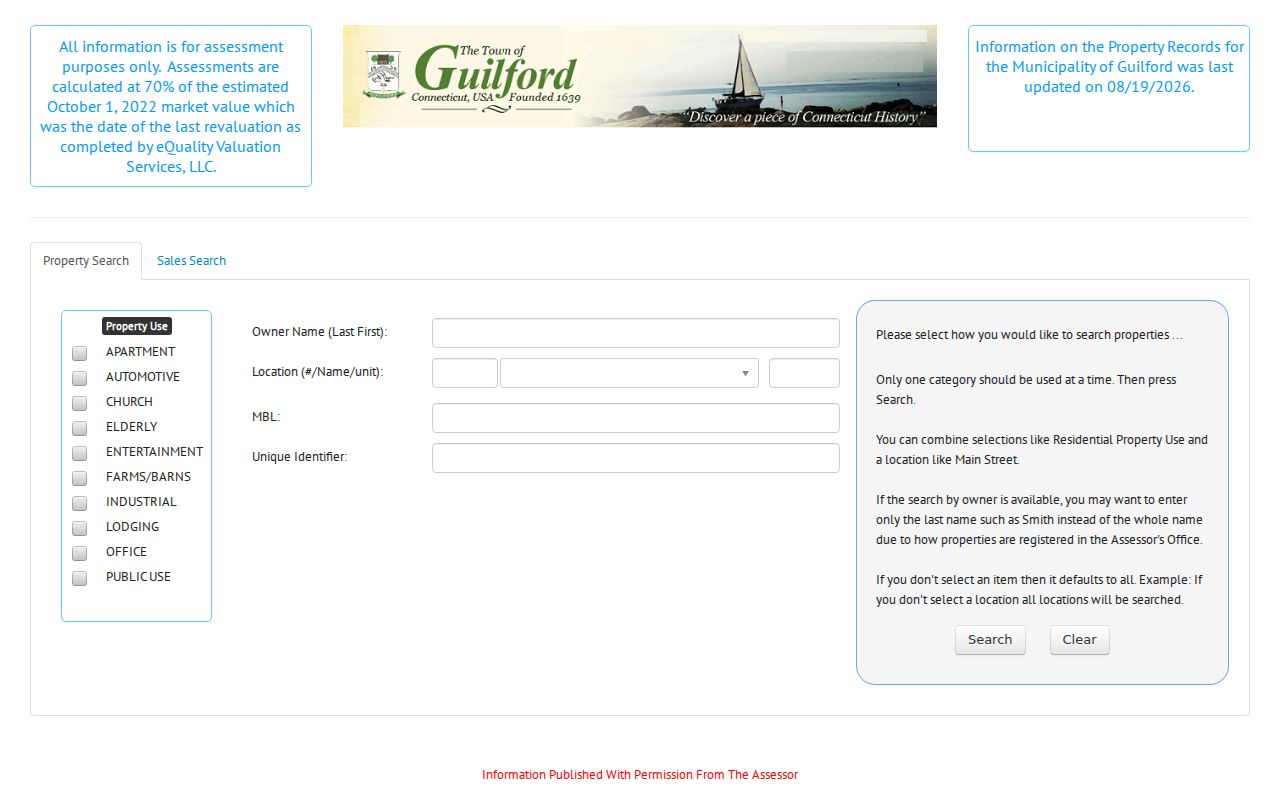
Open the blue street-name detail when it appears. Save the situs, mailing location, MBL, and update date as separate fields. A tax-mailing address can be a PO Box or an address outside Guilford. It clues the owner record, not who sleeps there.
Guilford's Current Resident Sources
No single current Guilford residents directory answers every question. The useful sources overlap. Each one lists a different kind of record subject, whether owner, registration, transaction, bill, or community context, and a public field in one source never describes a whole household. The table keeps those roles apart so a search stays grounded in what each record actually says.
| Source | What it can show | Keeper | Access note |
|---|---|---|---|
| Property card | Owner of record, situs, mailing, MBL, assessment | Guilford Assessor | Free public portal; not occupancy proof |
| Voter status | Current registration status and district context | Secretary of the State | Live fields not captured; protected rules apply |
| Deed index | Recorded parties, dates, document types, legal description | Town Clerk / RecordHub | Online land records begin 04/01/1972 |
| Tax bill | Bill, account, payment, and delinquency route | Tax Collector / MyTaxBill | No ZIP filter; verify with Town |
| Association page | Governance, events, places, public contact | Local organizations | Not an open member roster |
The Guilford MyTaxBill search accepts a last name with first initial, property number, bill and account numbers, tax ID, account ID, link number, or DBA. There is no ZIP filter. The Town's staff directory routes a question to a custodian rather than serving as a resident roll. For a person-specific question, the Guilford resident lookup workflow keeps each record role visible. A public association page adds place context. Membership lists stay private, though. Treat current sources as a chain of limited confirmations. One match should never stand in for a whole household.
Voter Status in a Guilford Lookup
For a live registration question, Guilford's Registrar of Voters points to the Connecticut Voter Registration Lookup. The statewide form can answer a status question. It shows district and precinct context, participation history, a birth year in the public release, and any protected or substitute-address flags. It never reveals ballot choices. Field labels and the result screen vary, so confirm them when you run a search.
The full centralized voter file takes a different route. Send a written request to the Secretary of the State's LEAD unit at P.O. Box 150470, Hartford, CT 06115, or email LEAD@ct.gov, with a reported $300 fee and phone 860-509-6100. Public-field and privacy limits apply to what the file releases. Guilford's 03/30/2026 street-list and voting-district PDF maps a street to its district, though it is not a searchable directory of Guilford names.
The state voter-status lookup carries the official route linked from the Registrar's page.
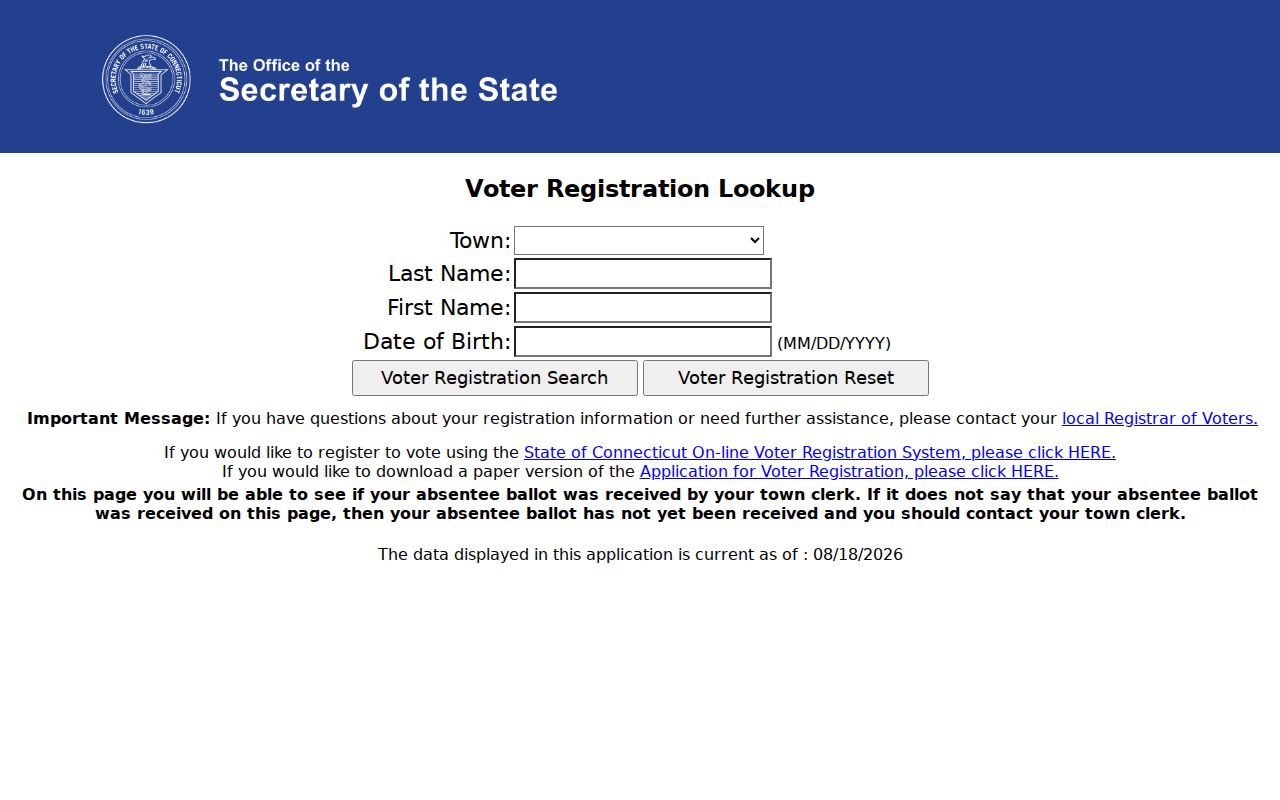
Treat a voter match as one dated status fact. It is not a household record, a ballot-choice record, or proof of continuous presence at a parcel.
RecordHub's Guilford Deed Trail
Guilford RecordHub is the town's online land-record service. It covers grantor and grantee names, deeds, mortgages, releases, liens, maps, surveys, and related instruments. The free index and images span 04/01/1972 through 08/19/2026, starting at Volume 192. Maps and surveys reach back to 10/30/1858 from Map 1. Trade names begin 01/05/1995. Live results can fail to load. So treat your findings as a field checklist until the pages open.
For each hit, note the party role and document type. Record the recording date, book/page or volume/page, document number, legal description, parcel or street language, image status, and any linked map. Simple Search stays broad. Expanded Search allows targeted fields and a date range. It also offers document categories and exact, BEGINS WITH, or CONTAINS modes. Name Directory surfaces spelling variants and document counts. Adding a second name with AND or OR can narrow a conveyance.
The RecordHub organization page hosts the Town Clerk's land-record service.
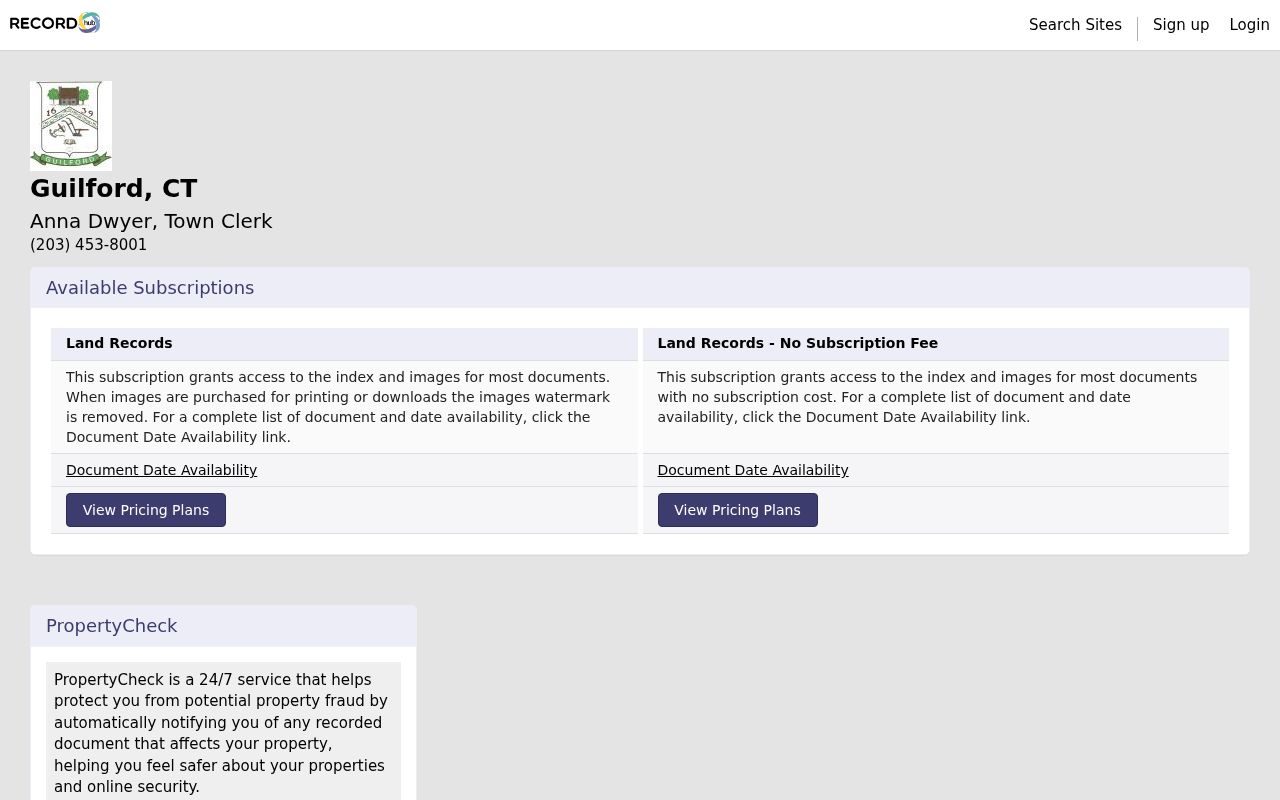
Build a parcel trail in steps. Search the current owner or address in the Assessor first. Then run that name as grantee. Run the seller as the next grantee. Legal description, map, lot, and MBL outweigh street text whenever an address changes. For pre-1972 work, turn to the Town Clerk's books and indexes. Library and archive sources serve as support.
Guilford Vital Records by Custodian
Vital records sit apart from an open residents directory. Birth, death, and marriage files in Guilford are held by the Town Clerk. The Connecticut Department of Public Health Office of Vital Records offers a second route. This statewide option covers events from 07/01/1897 forward. Match each request to the event, place, date, your relationship, and the copy type you need. The Town tends to move faster for local events. DPH casts a wider net across the state. But it warns that processing can run up to 12 weeks.
| Record | Guilford route | State route | Boundary to note |
|---|---|---|---|
| Birth | Town Clerk for local copies | DPH from 07/01/1897 | Under 100 years confidential except eligible applicants; public at 100 years |
| Death | Town event route | DPH certified copy | Generally available at 18+; post-07/01/1997 SSN portion is restricted |
| Marriage | Town of event or residence | DPH certified copy | Generally available at 18+; SSN portion has restricted access |
Fees follow the custodian. Certified copies usually cost $20 through the town, death, and marriage routes. A state birth certificate runs $30. The town birth form shows $20 for a full size and $15 for a wallet copy. That conflicts with the DPH summary. Confirm the current amount with Guilford before paying. Both town and state forms ask for the requester, the record, the relationship, ID, a signature, and mailing details. Mail and in-person requests both remain open. DPH names VitalChek as an approved online or phone vendor.
This split helps with family history. A certificate can confirm a parent, a spouse, a date, or a place. It does not prove where anyone lives now. Older events may point instead toward churches, EBN, the State Library, the State Archives, or FamilySearch. A current state certificate is not always the answer.
Guilford Courts and Probate Paths
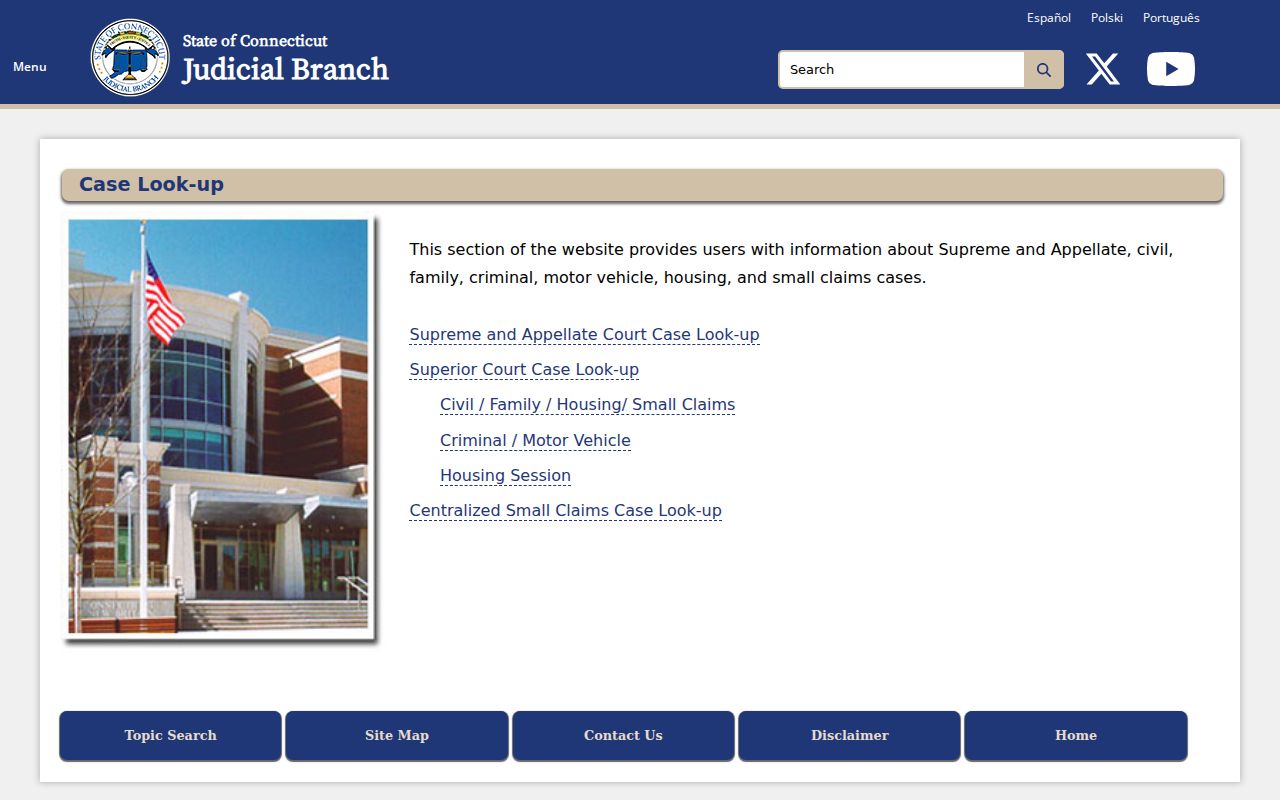
Guilford criminal and civil matters run through the New Haven Judicial District. Misdemeanors, infractions, and motor-vehicle cases land at 121 Elm Street. C, D, and E felonies go there too, and Part B and GA 23 sit at that address. Serious felony cases go to Part A at 235 Church Street. The Connecticut Judicial Branch case hub is the statewide doorway. It routes civil, criminal, family, small-claims, and motor-vehicle questions from one place. Probate works on its own track. Estates, fiduciaries, wills, and heir questions belong to the Madison-Guilford Probate District, numbered PD-34.
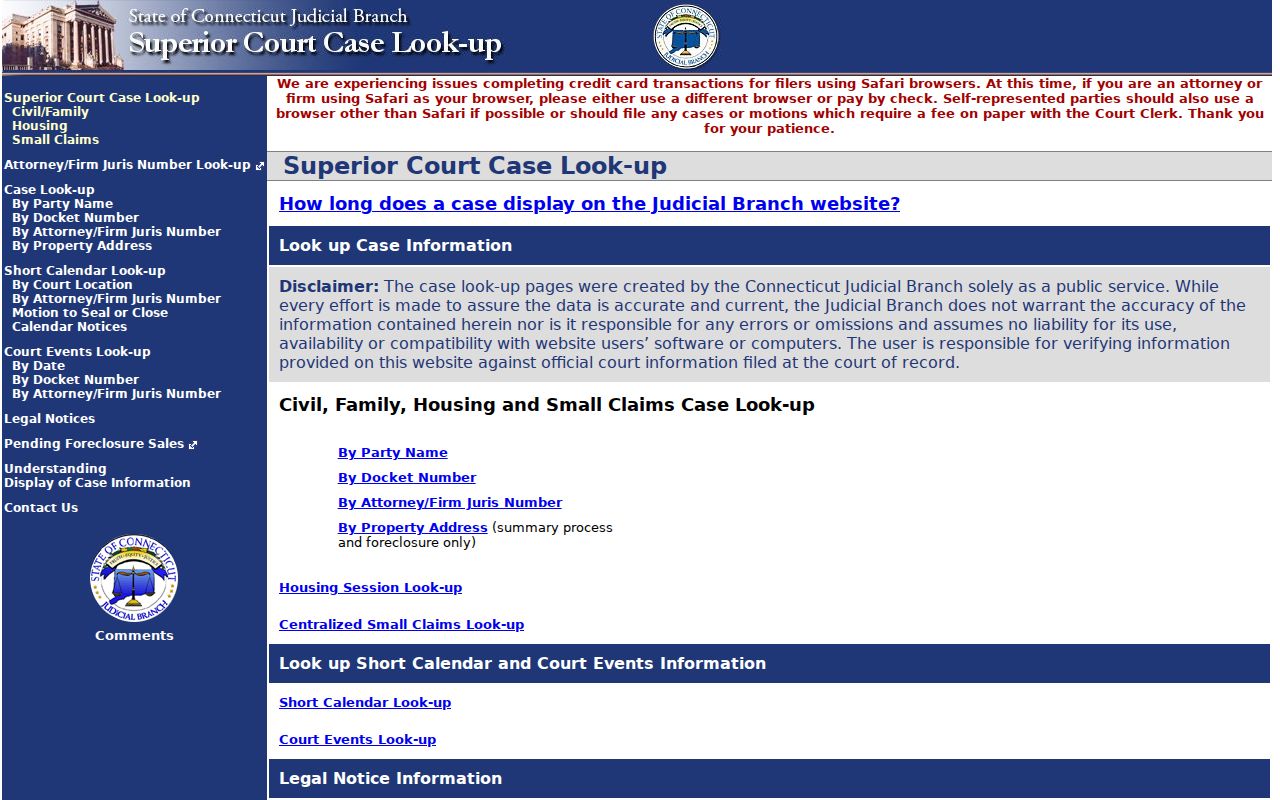
Civil lookups offer several entry points. Party name works for civil matters. So do docket number, attorney or firm jurisdiction, and court location. A limited property-address route also works. The pending criminal search demands a last name. First initial, birth year, a year range, court location, and category stay optional. Daily defendant and daily court pages depend on the date you pick. Treat any docket result as a clue, not a full identity history. Sealed, juvenile, medical, and protective-order records may be restricted. Other restricted records may still need a clerk or a courthouse public-access route.
The Judicial Branch case-look-up page displays the statewide hub. It routes Guilford court questions in one place.
The civil inquiry page covers the separate civil search path. It answers court questions, not parcel or household ones. Keep the two searches distinct.
Probate's online tools need an account. Non-confidential records still reach the public through a courthouse computer or the paper files. Federal cases shift to the District of Connecticut and PACER, and the court clerk can confirm which file or certification rule fits a given docket. Ask that office directly before assuming the route.
Historical Guilford Directory Shelf
Printed coverage of Guilford is anchored by the Connecticut River Valley directory from C. DeWitt White Co. That run lasted from 1913/14 to 1928. Gaps appear in 1917, 1920-1923, and 1925-1927 on the Gale-described reel. A 1913 Guilford town directory also survives. It is listed among the library's History Hunt sources. Its worked example starts from 7-11 Water Street and a movie-theater clue. A street section turns a bare house number into a dated business or household lead.
The EBN Historical Room complements its directories with exactly what fills their gaps. Holdings include early tax lists, maps, photographs, yearbooks, and newspapers. Census microfilm covers New Haven and Middlesex County from 1800 to 1930. The Connecticut State Library adds books, microfilm, and microfiche. The Library of Congress and institutional databases can supply missing volumes too. Treat later Ancestry and Boston Public Library leads as availability checks. They are not proof of any continuous Guilford run.
Work through the alphabetical name section and the street or address section on separate passes. Record the printed spelling. Note the street number, the town heading, and the page. Capture any business or relationship notation you can see. Then test the entry against a deed, a newspaper item, a census record, or an obituary. A directory earns its place in the Guilford city directory collections workflow once the historical shelf becomes the real question.
FOI for Missing Guilford Records
A town record missing from the online index still has a route. Connecticut's Freedom of Information Act opens it. C.G.S. §§1-200 through 1-242 govern the details. Sections §§1-210, 1-212, and 1-206 cover inspection, copies, fees, complaints, and appeals. The Guilford FOI route is the local starting point. Is the custodian unclear? Ask the Town Clerk which office holds a permit, an older property card, a report, or another file.
Name the record, the address or person, the date range, and your preferred delivery. No statewide form is required. An agency may still insist on a written request for copies. Prompt access is not the same as instant access. A denial carries a four-business-day rule for appeal purposes. The FOI Commission generally allows a 30-day appeal window. So confirm the Commission's current procedure before leaning on any deadline.
The Guilford request-route page shows the municipal starting point. Use it for a record that no index reaches.
Copy charges can apply. Municipalities cap copies at $0.50 per page, while the state ceiling under C.G.S. §1-212 is $0.25 per page. Actual-cost and certification rules govern some cases. Inspection without copies may cost nothing. Keep the request, the response, the fee estimate, and any denial together.
Safe Verification for Guilford Residents
A sound Guilford residents directory search ends with verification, not escalation. Match at least two independent details, such as date, place, relationship, address, MBL, or record role. For a common name, add a middle initial or surname variant, then ask the custodian about a specific record number or date. Each office owns its own fixes. The Assessor corrects parcel cards, the Registrar handles status questions, the Town Clerk handles recording issues, DPH sets vital-record rules, and court clerks manage docket files.
Privacy protections also shape what a resident lookup can show. Connecticut's Safe at Home Address Confidentiality Program gives qualifying participants a substitute address and mail forwarding. SOTS voter privacy can suppress a name and address when disclosure would create a safety risk. C.G.S. §1-217 shields residential addresses for listed protected roles. DMV personal data is not a public address source under C.G.S. §14-10 and the federal Driver's Privacy Protection Act. Never try to rebuild a protected address through a second record.
- Roll
- A list held for a defined public purpose, such as registration or assessment. It is not a complete household count.
- Index
- A finding aid that points to a record. The index may show less than the document image.
- Parcel
- A mapped piece of land identified by local fields such as MBL, map, lot, or unique ID.
- Criss-cross directory
- A historical address or street section that can lead from a place to a named person or business.
Use public records for lawful personal research, family history, property history, civic questions, or reconnecting. Do not use a name or address to stalk, harass, threaten, or harm anyone.
Scams deserve their own caution. Open the official Town, court, DPH, SOTS, or Treasury page yourself rather than trusting a mailed deed-copy letter, property-alert request, or unclaimed-money demand; check each against the custodian's published route. If a search raises an immediate safety concern, call local law enforcement or 911.